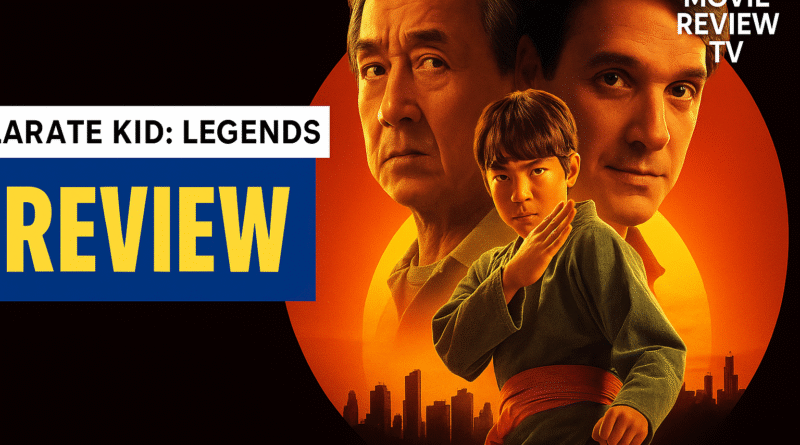
Karate Kid: Legends – Movie Review
Last Updated on October 22, 2025 by Movie Revew TV
Karate Kid Legends — Movie Review: a nostalgia-tinged reboot that tries to balance fresh characters with legacy tie-ins
Karate Kid Legends is the latest entry in the karate kid franchise, set against a New York backdrop. The film follows a young, martial-arts–trained kid and his mother as they relocate from Beijing to New York City and attempt to start over, blending kung fu roots with traditional karate tournament beats.
Logline: a former student of Mr. Han arrives in New York City with his mother, navigates schoolyard rivalries and family challenges, and becomes swept up in a story that mixes kung fu training and karate competition.
Quick verdict: Karate Kid Legends delivers enjoyable martial arts moments and fan-pleasing cameos but often feels torn between honoring the original Karate Kid legacy and establishing a standalone story — a tension that keeps the film from fully landing. Read on for a spoilers-free, full review.
The Plot Twist You Didn’t See Coming
Trailers frame Karate Kid Legends as a straightforward coming-of-age Karate Kid story, but the film quietly threads in a boxing subplot that reframes the stakes. Early on, we meet a pizza-shop owner (played in the film by Joshua Jackson) in New York City who is saddled with debt and a past life as a boxer; his struggles briefly become a local, human anchor for the kid’s arc.
The film subverts the usual “kid learns from master” template: the protagonist — a kung prodigy with lineage tied to Mr. Han — ends up coaching Jackson’s character on movement and timing. Instead of rote karate drills, the kid focuses on balance, redirection, and footwork, teaching the older fighter how kung fu principles can sharpen defense and improve counters in the ring. In one compact training beat the kid drills weight shifts and momentum redirection; the result is a cleaner counterpunch in a local match that helps save the pizza shop’s pride if not its finances.
Those scenes provide an inventive way to show how martial arts cross disciplines and give the story local stakes in New York. Choreographically, the film favors small, precise exchanges — close-footwork drills, pivoting for angles, and timing exercises — rather than broad, cinematic flourishes. That grounded approach pays off in parts: it makes the training feel plausible and lets the kid’s kung fu background read as practical, not performative.
But the boxing thread is unevenly integrated into the larger Legends story. While the idea of a young prodigy coaching an older local karate champion is fresh for the karate kid mythos, the subplot is sometimes sidelined as the movie pivots to franchise callbacks and cameos. The boxing arc gives the film useful local texture and emotional beats, yet it can feel shoehorned when the main narrative shifts back to tournament setup and legacy moments.
Next: how Karate Kid Legends handles legacy cameos and whether those callbacks help or hurt the new characters’ development.
The Cameos and Nostalgia Bait
Karate Kid Legends leans on legacy casting as part of its commercial playbook: Jackie Chan and Ralph Macchio both appear, and their presence explicitly links this new film to the broader Karate Kid universe and Cobra Kai continuity. Chan’s material is threaded with archival reference to Karate Kid II while the movie adds new connective beats; Macchio’s concise scenes carry the weight of Daniel LaRusso’s legacy and function as reassurance for longtime fans.
On a fan-service level, those moments land — seeing Jackie Chan and Ralph Macchio share franchise space is designed to tug at nostalgia — but they also create tonal whiplash. The film repeatedly shifts from character-driven setup to celebratory legacy moments, and those interruptions can undercut the development of the new cast. A promising conversation between the kid and his love interest, for example, is cut short by a montage that cues the legacy cameo, which reduces the time audiences spend investing in fresh characters.
Specifically, Chan’s scenes rely partly on archival footage (a brief clip tied to Karate Kid 2) while the editing overlays new footage to make his inclusion feel earned rather than a simple clip reel. Macchio’s turn is short but resonant — more of a bridge to Daniel LaRusso-era themes than a full role — and it functions as a quiet, grounding presence rather than a dominating performance.
Where the movie falters is in prioritization: the cameos often interrupt the kid’s arc, the pizza-shop subplot and the budding romance. Rather than weaving legacy moments into new-character beats, the film sometimes treats nostalgia as the destination, not the means. That choice leaves parts of the Legends story feeling familiar but flat, as if the movie uses franchise callbacks to generate emotional responses instead of building those responses through the new characters themselves.
That said, for viewers who follow the franchise closely, these interactions — Chan trading brief philosophical notes and Macchio offering a reassuring presence — will satisfy. They act as connective tissue between past and present, and when handled sparingly they reward viewers who bring franchise knowledge to the screening. A tighter edit, however, would better balance legacy goodwill with space for the new cast to breathe.
Where Did the Romance Go?
Early in Karate Kid Legends the romance between the kid (played by the new lead) and his love interest (played with warmth by Sadie Stanley) lands naturally — a few quiet scenes (shared noodles on a stoop, a conversation about missing home) establish chemistry and give the kid stakes beyond the tournament. Those moments help the story feel like more than a sequence of fights: they root the protagonist’s choices in family, belonging, and the immigrant experience of starting over in New York.
As the film progresses, however, the romantic thread receives less screen time. Intimate beats — the shared meal, a confessional about parents, a supportive text exchange — are shortened or bumped in favor of training sequences, legacy cameos, and the tournament build-up. The effect is that the relationship reads as episodic rather than developmental: we see sparks, but not enough connective scenes to make their bond feel earned by the final act.
This is most evident in the climax. The tournament sequence, framed as the karate competition intended to resolve the kid’s arc, arrives with brisk pacing and fewer connective montages than fans of the original Karate Kid might expect. Where the 1984 film used extended montage and buildup to turn the final match into an emotional payoff, Legends moves through matches more quickly, and the reduced montage time undercuts the romantic payoff that should have accompanied the kid’s growth.
If the filmmakers had rebalanced screen time — for example, adding one extra mid-film scene where the romance intersects with the boxing subplot or inserting a short montage of the couple supporting each other during training — the relationship would have carried more emotional weight into the semi-final and final matches. As it stands, the romance works in isolated moments but often feels secondary to spectacle and nostalgia-driven beats.
If you are a lover of perry’s film we review – Straw – Netflix Movie Review here
Two Scripts, One Movie
Karate Kid Legends often feels split between two competing ambitions: telling a grounded coming-of-age story about a young martial artist finding his place in New York and delivering a nostalgia-heavy, franchise-friendly experience for longtime fans. Clocking in at roughly 90 minutes, the film keeps a brisk pace, but that brevity sometimes works against it — there isn’t always enough room to develop every subplot fully.
At its core the movie has a solid center: a kid with established kung fu training navigating school, family, and local obligations. The pizza-shop subplot and the boxing thread give Legends useful local stakes, and Ming-Na’s character (the kid’s mother) gets a few meaningful beats that anchor the family side of the story. Still, several supporting arcs feel squeezed by the film’s split focus.
The attempt to fuse martial-arts traditions — the protagonist’s kung fu background with classic karate tournament beats — is intriguing on paper. There’s a sequence where mentor figures echo Mr. Han and Daniel-style guidance as they discuss timing and technique, a nod to the karate kid canon. But those moments often read like fan-service iterations of themes explored in Cobra Kai and other franchise entries rather than bold innovation: familiar ingredients dressed up as novelty.
Choreography and stunt work are generally competent. Training scenes and matches are staged clearly, with an emphasis on tight footwork, timing, and realistic contact rather than overly stylized flourishes. That approach lets the kid’s skills feel credible — he’s not a blank-slate novice — and it provides some genuinely satisfying martial arts beats.
However, the film’s editing and sound design sometimes undercut momentum. Pacing can feel choppy: a scene will cut away just as an emotional thread begins to develop, or music choices will emphasize style over character nuance. Those technical decisions make it harder to stay fully invested when the narrative keeps shifting between tournament, cameos, and local drama.
Bottom line: Karate Kid Legends has moments that work — a believable local story, reliable fight choreography, and a lead who sells his skills — but its dual-script ambition and occasional technical missteps stop it from being a fully cohesive film. Fans of the kid franchise and viewers who enjoy martial arts movies with nostalgic callbacks will find plenty to like; viewers seeking a wholly new karate movie might be less satisfied.
What worked:
- Concise, well-staged martial arts moments and believable choreography.
- A lead who feels credible and grounded, not just a plot device.
- Connective nods to the Karate Kid legacy that reward longtime viewers.
What didn’t:
- Underdeveloped supporting arcs and a romance that never fully matures.
- Uneven pacing and editing choices that interrupt emotional beats.
- A tendency to prioritize cameos and nostalgia over character depth.
Recommendation: Recommend for franchise fans and viewers who enjoy martial arts movies with strong nostalgic callbacks; consider skipping if you want a standalone, novel karate film experience. For current Rotten Tomatoes scores, box office figures, and broader reviews, check aggregator sites for the latest metrics.
Have you seen Karate Kid Legends? Do you prefer nostalgia-driven sequels or fresh takes in a kid franchise? Share your thoughts in the comments or on social with #KarateKidLegends.
Related movie Review we have: How to Train Your Dragon (2025) – Movie Review