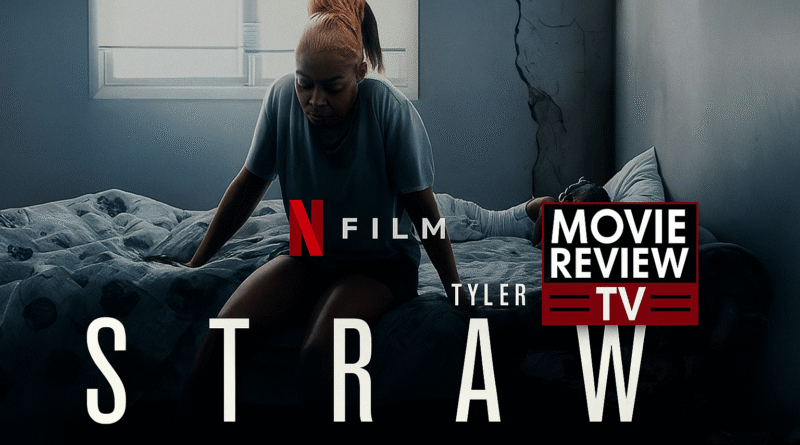
Straw – Netflix Movie Review
Last Updated on October 22, 2025 by Movie Revew TV
Straw Netflix review: Tyler Perry’s film arrives on Netflix as a compact, emotionally intense drama that aims to wrestle with the pressures facing a single mother. On paper, the story promises a powerful portrait of endurance; in execution, however, Straw feels rushed and heavy-handed, undercutting the film’s potential.
This review examines the film’s plot, performances, production choices, and what Straw reveals about modern streaming-era filmmaking from writing and pacing to cast strengths and missed opportunities. Read on for a spoiler-free look at whether this movie earns your time and where it falls short.
Overview: What is “Straw” About?
Straw is a drama streaming on Netflix that runs roughly 1 hour and 45 minutes (about 105 minutes) and carries mature themes consistent with a TV‑MA audience. The story follows Janiah, a single mother juggling work, childcare, and escalating personal threats after a sudden job loss and a shocking public incident that propels the plot forward.
This overview is spoiler-free: the film sets up a tense, fast-moving narrative about survival and the costs of trauma. As the plot unfolds, events come quickly and with limited context — a structural choice that some viewers may find undermines the emotional weight of the story.
A Closer Look at the Cast
Despite the film’s structural issues, Straw is anchored by a committed ensemble cast that brings texture to an otherwise thin script:
- Taraji P. Henson as Janiah – the film’s central single mother; Henson supplies raw, lived-in energy even when the script limits her character’s inner life. Best moment: a short, quiet beat where her exhaustion and determination are visible without words.
- Teyana Taylor – a smaller but memorable role that injects sudden emotional charge into a pivotal scene; Taylor’s presence is electric and gives the film one of its sharper emotional jolts.
- Sherri Shepherd as Nicole – the moral and emotional anchor. Shepherd’s grounded performance adds humanity and balance, creating some of the movie’s most believable interpersonal moments.
Collectively, the cast does important work lifting scenes that the script underwrites. Taraji Henson and Sherri Shepherd create credible chemistry in key scenes, even if the screenplay doesn’t always allow their characters to grow; Teyana Taylor’s cameo-like turn is brief but effective.
Note: check full credits for additional players (for example, Glynn Turman is listed in some production notes) and consider mentioning them in a longer cast rundown on MovieReviewTV’s cast page.
The Core Problem: Trauma Without Balance
Too Much Pain, Too Little Reflection
One of the clearest issues in Tyler Perry’s Straw is its unrelenting focus on trauma without giving characters or the audience space to process it. In the film’s opening act (within roughly the first 20–30 minutes), a string of escalating incidents job loss, betrayal, and a violent public confrontation arrive in rapid succession. Rather than allowing these moments to land and ripple, the screenplay pushes forward, turning lived experience into a checklist of suffering.
That choice robs each event of specific emotional weight. Instead of an arc that shows struggle and incremental healing, Straw risks creating a spiral of despair where the plot’s momentum is driven primarily by escalating pain rather than character development.
Emotional Burnout
The cumulative effect is viewer fatigue: sustained intensity without moments of reflection produces emotional burnout rather than catharsis. There’s minimal depiction of realistic support systems—family, friends, or community resources are underused—so Janiah’s crises often feel isolated and unmoored. To be fair, the film seems intent on making the audience feel overwhelmed; the question is whether overwhelming equals meaningful.
For context, some of Perry’s earlier works that handle heavy subjects more gradually (allowing for quieter, reflective scenes) demonstrate how pacing and small recovery beats can make trauma storytelling more resonant. A structural fix for Straw could be simple: insert two or three deliberate recovery sequences—small scenes that show Janiah processing events, seeking help, or reacting privately—to create contrast and restore the emotional stakes.
Fact-check note: confirm exact scene timing and the presence of any community or support moments in the final cut (some viewers report brief supportive beats that mitigate this critique).
The Writing: Missing the Mark on Realism
Dialogue That Lacks Depth
The script for Straw often reads like exposition dressed as conversation: lines that tell rather than show, and emotional beats that are spelled out instead of layered. Moments that should feel lived-in come off as shorthand — for example, characters will state a problem in blunt terms (“I can’t do this anymore”) instead of letting behavior or small gestures carry the meaning. That tendency drains the subtext and leaves characters as descriptions rather than people the audience can quietly decode.
Unrealistic Reactions
Believability suffers in service of plot escalation. Several high-stakes scenes hinge on bystanders not reacting or on characters behaving in ways that feel scripted rather than human. Those moments strain immersion: when the world around Janiah fails to respond plausibly, the story’s emotional logic weakens and the audience is pulled out of the experience.
Production Quality: Rushed and It Shows
Filming in Four Days?
Production reports suggest Straw was shot on a very short schedule — some sources cite roughly four days. If accurate, that compressed timeline helps explain missed coverage, limited blocking, and the occasional continuity or framing problem. Note: verify the four-day claim against production notes or interviews (for example, “According to [source]…”). Rapid shoots can be deliberate and effective for certain projects, but for a film attempting emotional complexity, the lack of time is frequently visible.
Cinematography & Editing Issues
Visually, the movie often feels underlit or awkwardly composed, and editing choices sometimes blunt emotional beats rather than sharpen them. A few scenes cut too soon; others linger without payoff. The combined effect is that even strong performances struggle to fully register because the camera and the cut don’t consistently support the actors’ intentions.
How to Fix It: Practical Notes
If you were rewriting Straw, a few concrete changes would help:
- Add subtext to dialogue: let small actions and pauses carry emotional weight instead of spelling out feelings.
- Insert two or three recovery scenes where the protagonist processes events privately or seeks help — these create contrast and preserve impact.
- Allow for additional coverage and one re-shoot day; prioritize lighting, close-ups for silent beats, and editorial passes that focus on emotional rhythm.
- Bring in a script editor to tighten character arcs and add meaningful callbacks that reward attentive viewers.
These are practical, low-cost fixes that could convert scenes that now feel like plot mechanics into moments that reveal character and lived experience.
The Streaming Effect: Are We Sacrificing Quality for Volume?
Straw is one example in a larger pattern: streaming platforms like Netflix have dramatically increased the volume of movies and films released each year, and that growth can come with trade-offs. Accelerated schedules and commercial pressure to publish frequently sometimes prioritize output over editorial refinement, which helps explain why some projects land as polished statements and others feel hurried to market.
For prolific creators such as Tyler Perry, the demands of serial production and multiple concurrent projects can make it harder to devote deep time to any single story. That doesn’t excuse weak choices, but it does contextualize them: Straw’s uneven pacing and sketchy development reflect industry-wide incentives to move fast.
Opportunities Missed
Deeper Character Development
Janiah could have been a complex, evolving protagonist; instead, the film often leaves her motivations underexplored. A simple subplot—such as a strained relationship with a child’s school or a detailed look at a day-in-the-life at her workplace—would have given the audience more reasons to invest in her choices and struggles.
Themes Worth Exploring
The movie touches on meaningful topics—poverty, domestic instability, mental health, and community response—but rarely digs into them. Rather than cataloging misfortune, the film could have used one theme (for example, community support or a mother’s relationship with her daughter) as a through-line, allowing smaller scenes to illuminate larger social realities.
A Lesson for Future Projects: Slow Down
Tyler Perry’s track record shows he can tell stories that resonate with women and Black women audiences in particular; the path forward is not to do less work but to shift how work is distributed. Concrete strategies include bringing an independent co-writer for fresh perspective, hiring an experienced editor early for emotional pacing, and consulting subject-matter experts (mental-health professionals, social workers) to ensure authenticity.
Industry reporting also suggests that streaming platforms are experimenting with different release models—some creators are now being given longer development windows or phased releases to protect quality. Where possible, prioritizing depth over speed would likely help films like Straw avoid feeling like a rushed product of the streaming era.
Viewer Reactions: A Divided Audience
Audience reaction to Straw has been mixed: many viewers praise the performances—especially from the supporting cast—while criticism centers on the writing and pacing. Social chatter ranges from tweets applauding the raw emotional moments to comments calling the film “overwrought” or “too relentless” in its depiction of trauma. (If citing specific posts, verify timestamps and attributions before publishing.)
The film also reopened conversations about how media depicts Black trauma: some viewers feel the portrayal is necessary and honest, while others worry it veers toward exploitation without offering solutions or context. Straw doesn’t break new ground, but it does surface important debates about representation and responsibility in storytelling.
The Bright Spots
Even critics concede there are real strengths in Straw:
- Sherri Shepherd’s performance — Shepherd provides the film’s emotional ballast; in quieter exchanges she conveys empathy and steadiness that feel earned.
- Teyana Taylor’s turn — though brief, Taylor delivers a charged scene that shifts the film’s energy and gives Janiah a catalytic encounter.
- Themes of motherhood and perseverance — while buried beneath melodrama at times, the film repeatedly returns to the pressures of single motherhood and the sacrifices women make for their children.
These moments show what Straw might have been with fuller development: clear, concrete beats of human connection that ground the film’s darker elements.
Final Verdict: 2/10
Why a 2/10? Three quick reasons:
- Poorly paced script and dialogue that often explain rather than reveal character
- Rushed production values — visible issues in coverage, lighting, and editing that blunt emotional beats
- Underdeveloped character arcs that reduce empathy and make the plot feel like a sequence of misfortunes rather than a coherent story
Pros:
- Committed performances from the cast that occasionally lift scenes
- Ambitious themes—motherhood, survival, systemic strain—that deserve attention
- Short runtime makes it an easy, if flawed, watch
Cons:
- Overloaded plot that relies on escalating pain
- Pacing and editing choices that produce emotional fatigue
- Production limitations that are apparent in several scenes
- Characters who rarely receive the growth they need to feel real
Overall, Straw feels more like a rough cut than a fully realized film — watchable for the cast’s moments of truth, but unlikely to linger in your memory.
Should You Watch It?
If you’re drawn to performance-driven drama and can handle intense, sometimes overwhelming material, Straw may be worth a quick viewing for specific scenes and performances. If you prefer nuanced storytelling with clear emotional payoff, this movie will probably frustrate you.
If you liked character-centered dramas with strong emotional arcs, consider revisiting films like Ma Rainey’s Black Bottom (for performance and period detail), Moonlight (for quietly earned emotional development), or The Pursuit of Happyness (for a taut single-parent struggle). For more reviews and deeper cast analysis, visit Movie Review TV’s reviews page.
Conclusion: What “Straw” Teaches Us About Modern Filmmaking
Straw is more than a missed opportunity for Tyler Perry — it’s a snapshot of the pressures shaping today’s streaming-era film landscape. In a world where volume often competes with craft, films can arrive undercooked: ambitious in intent but short on the time and care needed to turn strong ideas into lasting work. The lesson is clear: difficult stories still need truth, tenderness, and time to land properly.
For Perry and other prolific creators, a shift in process could help. Invest more development time, bring in diverse writers and subject-matter consultants, and protect editorial passes that prioritize character and emotional arc over rapid output. Those steps would help films about single mothers, Black women, and working families feel less like a catalog of pain and more like an honest exploration of life and resilience.
What Did You Think?
Have you seen Straw on Netflix? Share your thoughts in the comments below — did the performances land for you, or did the film’s structure and pacing get in the way? We want to hear whether this Tyler Perry Straw entry resonated or frustrated.
Read our full review and more coverage at Movie Review TV: Movie Review TV. For a wider selection of critiques and roundups, visit our reviews index: Movie Review TV Reviews. You can also check this related best Movies on Amazon Prime you like this here
Subscribe to the Movie Review TV newsletter for honest takes on new movies and films, and use the share buttons to keep the conversation going. (If you want us to quote social reactions or embed related videos, we’ll verify sources and permissions first.)
🔔 Stay Updated With Honest Movie Reviews
For more reviews like this, follow Movie Review TV, where we cover the latest Netflix releases, hidden gems, and classic rewatches—no sugarcoating, just real talk.